Today's Consultation
“I've been treating my acne with three different Reddit routines for eight months and the scarring is getting worse.”
— Booked a skin check · 40 min ago
Real questions. Real answers.
The questions your last doctor didn't have time to answer — with the diagrams, comparisons, and explanations they should have drawn on a notepad.
During pregnancy, elevated estrogen and progesterone stimulate melanocytes — the pigment-producing cells in your skin's basal layer — to overproduce melanin. The patches you see on your cheeks, forehead, and upper lip are called chloasma, and they're among the most treatment-resistant pigmentation conditions we see.
Why sun makes it permanent
What actually works: Prescription-strength hydroquinone combined with tretinoin and a mid-potency steroid (the “triple cream”) remains the gold standard. We pair this with rigorous SPF50+ protocol and, for deeper pigmentation, a series of low-fluence Q-switched laser sessions. Over-the-counter vitamin C serums and niacinamide maintain results but rarely achieve them.
Important: Starting treatment within 12 months of onset significantly improves clearance rates. Waiting longer allows deeper dermal pigmentation to set.
Cystic acne forms when a follicle ruptures beneath the skin's surface. The resulting inflammatory cascade is deep — often reaching the reticular dermis — and if that inflammation persists (or is repeatedly triggered by incompatible actives), the body lays down collagen disorganizedly, creating the ice-pick and boxcar scars you're seeing.
| Approach | What it does | Risk |
|---|---|---|
| Reddit multi-step layering | Exfoliates + moisturizes + treats | Barrier disruption, purging cycles |
| OTC benzoyl peroxide 10% | Kills P. acnes bacteria | Oxidative stress, hyperpigmentation |
| Prescription isotretinoin | Shrinks sebaceous glands at source | Monitored bloodwork required |
| Intralesional corticosteroid | Collapses active cyst in 24–48h | Atrophy if overdosed — clinic only |
For active cysts, an intralesional corticosteroid injection in-office can flatten a lesion within 24–48 hours — stopping the scar before it forms. For existing scarring, subcision combined with microneedling with PRP has the strongest evidence base for atrophic acne scars.
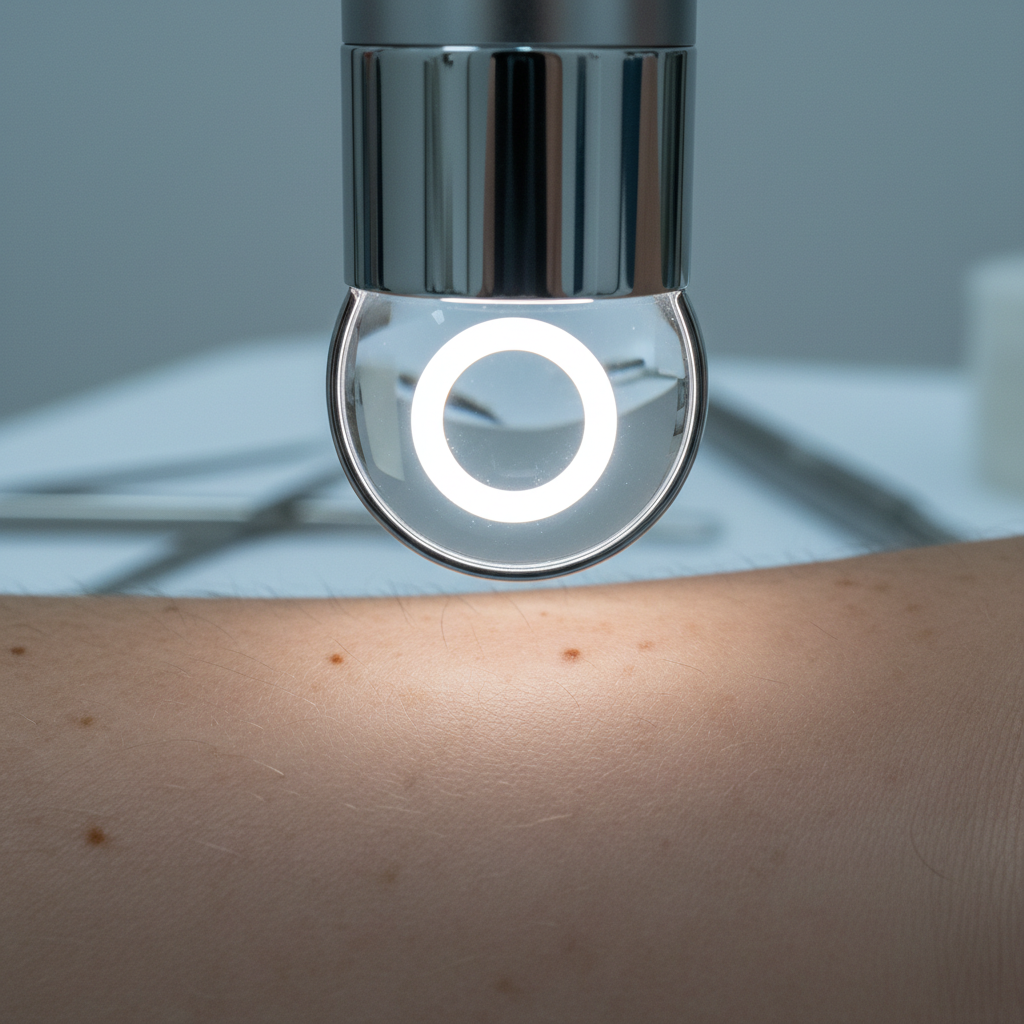
The ABCDE criteria your GP used to flag the lesion is a screening tool, not a diagnosis. Only dermoscopy — a handheld device that illuminates subsurface structures invisible to the naked eye — can assess the vascular patterns and pigment networks that differentiate a dysplastic nevus from an early melanoma.
Melanoma caught at Stage I has a 5-year survival rate above 98%. The urgency your GP communicated is appropriate — not because the outcome is likely to be bad, but because acting quickly keeps it that way.
Atopic dermatitis is a disease of barrier dysfunction. Your skin lacks adequate ceramides — the lipid molecules that seal moisture in and irritants out. In winter, low humidity accelerates transepidermal water loss (TEWL), and central heating compounds it. The result: a compromised barrier that lets allergens and irritants trigger the immune cascade you experience as a flare.
Why prescriptions lose effectiveness
Tachyphylaxis — the skin's receptor downregulation to repeated corticosteroid exposure — typically develops within 2–4 weeks of continuous use. We manage this with pulse dosing: weekends-only application during remission, or rotation to a non-steroidal alternative like tacrolimus ointment.
The barrier repair protocol
- Ceramide-dominant moisturizer within 3 min of bathing
- Lukewarm water only (hot water dissolves lipids)
- Wet wrap therapy for acute flares
- Dupilumab (biologic) for moderate-severe cases
Both procedures stimulate collagen remodeling, but through fundamentally different mechanisms — and they treat different skin concerns most effectively.
| — | Chemical Peel | Microneedling |
|---|---|---|
| Mechanism | Chemical exfoliation of epidermis/upper dermis | Micro-punctures trigger wound-healing cascade |
| Best for | Pigmentation, sun damage, fine lines | Acne scars, texture, laxity |
| Depth | Superficial (AHA) to deep (TCA, phenol) | 0.5–2.5mm needle depth, adjustable |
| Downtime | 2–7 days (peeling, redness) | 24–48h redness, 5–7 days full heal |
| Sessions | 3–6 for full course | 3–6 spaced 4 weeks apart |
| Fitzpatrick IV–VI | Superficial peels only — PIH risk | Generally safe all skin tones |
For most patients seeking both pigmentation correction and texture improvement, we recommend a staged combination protocol: a series of superficial peels first to address surface pigmentation, followed by microneedling with PRP for structural remodeling. This sequencing matters — the reverse order risks post-inflammatory hyperpigmentation.
Every concern, every depth.
From cosmetic curiosity to urgent medical referral — we treat the full spectrum, in-office and via teledermatology.

Acne & Scar Revision
From active cystic acne to post-inflammatory scarring. Isotretinoin protocols, intralesional injections, subcision, and microneedling with PRP.
Eczema, Psoriasis & Chronic Conditions
Barrier repair protocols, biologic therapy consultation, and steroid-sparing regimens that actually hold.
Melasma & Pigmentation
Triple-cream protocols, Q-switched laser, and maintenance programs for postpartum and hormonal pigmentation.

Teledermatology
Board-certified consults from home. Prescription-capable in 48 states. Ideal for follow-ups and non-urgent concerns.
“I'd been treating my melasma with vitamin C serums for two years. In one appointment she showed me exactly why they weren't working and had me on a real protocol the same day.”
Amara Osei
Postpartum melasma · NYC
“My GP flagged a mole on a Thursday. I had a dermoscopy and biopsy Friday morning. Pathology came back benign. The speed mattered.”
Robert Gallagher
Mole screening · Referred by GP
“She explained tachyphylaxis to me — why my steroid cream stopped working — in a way my last three dermatologists never did. I finally understood what was happening.”
Priya Nambiar
Atopic dermatitis · 6-year patient
Your chart is waiting. The light is even.
Tell us what's on your skin — we'll match you with the right appointment type and have a confirmation in your inbox within the hour.
Free: Mole Self-Check Guide
A board-certified dermatologist's printable guide to the ABCDE criteria with real dermoscopy examples.